Cupping therapy is a form of alternative medicine in which a local suction is created on the skin with the application of heated cups. Its practice mainly occurs in Asia but also in Eastern Europe, the Middle East, and Latin America.[1][2] Cupping has been characterized as a pseudoscience and its practice as quackery.[3][4]
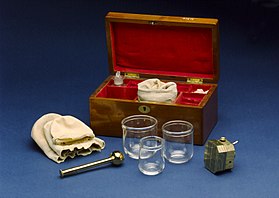
Cupping practitioners attempt to use cupping therapy for a wide array of medical conditions including fevers, chronic low back pain, poor appetite, indigestion, high blood pressure, acne, atopic dermatitis, psoriasis, anemia, stroke rehabilitation, nasal congestion, infertility, and menstrual period cramping.[1][2] Despite the numerous ailments for which practitioners claim cupping therapy is useful, there is insufficient evidence it has any health benefits and there are some risks of harm, especially from wet cupping and fire cupping.[1] Bruising and skin discoloration are among the adverse effects of cupping and are sometimes mistaken for child abuse.[2] In rare instances, the presence of these marks on children has led to legal action against parents who had their children receive cupping therapy.[2]
Scientific evaluation
Safety
Methods
Cupping practitioners use cupping therapy for a wide array of medical conditions including fevers, pain, poor appetite, indigestion, high blood pressure, acne, atopic dermatitis, psoriasis, anemia, stroke rehabilitation, nasal congestion, infertility, and dysmenorrhea.[1] Proponents claim cupping has a therapeutic effect and removes unspecified "toxins", stagnant blood, or "vital energy" when used over acupuncture points with the goal of improving blood circulation.[1][2] Modern suction devices are sometimes used instead of the traditional cups.[2]
While details vary between practitioners, societies, and cultures, the practice consists of drawing tissue into a cap placed on the targeted area by creating a partial vacuum – either by the heating and subsequent cooling of the air in the cup, or via a mechanical pump.[21] The cup is usually left in place for somewhere between five and fifteen minutes.
Cupping therapy types can be classified using four distinct methods of categorization. The first system of categorization relates to "technical types" including: dry, wet, massage, and flash cupping therapy. The second categorization relates to "the power of suction related types" including: light, medium, and strong cupping therapy. The third categorization relates to "the method of suction related types" including: fire, manual suction, and electrical suction cupping therapy. The fourth categorization relates to "materials inside cups" including: herbal products, water, ozone, moxa, needle, and magnetic cupping therapy.[22]
Further categories of cupping were developed later. The fifth relates to area treated including: facial, abdominal, female, male, and orthopedic cupping therapy. The sixth relates to "other cupping types" that include sports and aquatic cupping.[23]
- Cups of various materials

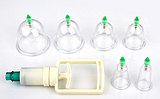
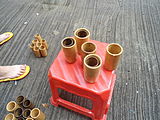
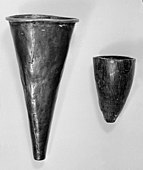

Dry cupping
Dry cupping involves the application of a heated cup on the skin of the back, chest, abdomen, or buttocks.[1] The cooling of the air is then thought to create a suction effect. Bamboo and other materials are sometimes used as alternatives to glass cups.[1]
Fire cupping
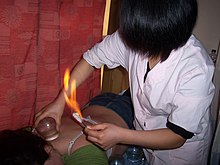
Fire cupping involves soaking a cotton ball in almost pure alcohol. The cotton is clamped by a pair of forceps and lit via match or lighter, and, in one motion, placed into the cup and quickly removed, while the cup is placed on the skin. The fire uses up all the oxygen in the cup which creates a negative pressure inside the cup. The cup is then quickly placed onto the body and the negative pressure "sucks" the skin up. Massage oil may be applied to create a better seal as well as allow the cups to glide over muscle groups (e.g. trapezius, erectors, latissimus dorsi, etc.) in an act called "gliding cupping" or "sliding cupping". Dark circles may appear where the cups were placed because of capillary rupture just under the skin. There are documented cases of burns caused by fire cupping.[24][25]
Wet cupping
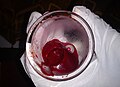
Wet cupping is also known as Hijama (Arabic: حجامة lit. "sucking") or medicinal bleeding, where blood is drawn by local suction from a small skin incision.[26]
The first reported usages are found in the Islamic hadith, sayings attributed to or describing the actions of the Islamic prophet Muhammad.[27][28] Hadith from Muhammad al-Bukhari, Muslim ibn al-Hajjaj Nishapuri and Ahmad ibn Hanbal support its recommendation and use by Muhammad.[29] As a result, wet cupping has remained a popular remedy practiced in many parts of the Muslim world.[30]
In Finland, wet cupping has been done at least since the 15th century, and it is done traditionally in saunas. The cupping cups were made of cattle horns with a valve mechanism in it to create a partial vacuum by sucking the air out.[31] Cupping is still practiced in Finland as part of relaxing and/or health regimens.[32]

Traditional Chinese medicine
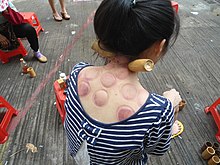
In Chinese, cupping is known as "pulling-up jars" (Chinese: 拔罐; pinyin: báguàn). According to traditional Chinese medicine (TCM), cupping is done to dispel stagnation (stagnant blood and lymph), thereby improving qi flow,[33] in order to treat respiratory diseases such as the common cold, pneumonia and bronchitis. Cupping also is used on back, neck, shoulder and other musculoskeletal conditions. Its advocates claim it has other applications as well.[33] Cupping is not advised, in TCM, over skin ulcers or to the abdominal or sacral regions of pregnant women.[34]
Society and culture
Cupping has gained publicity in modern times due to its use by American sport celebrities including National Football League player DeMarcus Ware and Olympians Alexander Naddour, Natalie Coughlin, and Michael Phelps.[35] Medical doctor Brad McKay wrote that Team USA was doing a great disservice to their fans who might "follow their lead", calling cupping an "ancient (but useless) traditional therapy."[36] Steven Novella noted "It is unfortunate that elite athletics, including the Olympics, is such a hot bed for pseudoscience."[37]
There is a description of cupping in George Orwell's essay "How the Poor Die", where he was surprised to find it practiced in a Paris hospital.[38]
Perceived benefits of cupping have often been perpetuated by celebrities and athletes who use these therapeutic interventions in their daily lives. Professional swimmer Michael Phelps received publicity during the 2016 Olympics for the purple bruises evident on his back resulting from cupping. He has been known to "do it before every meet he goes to" in order to "speed up recovery".[39] Celebrity endorsements similar to Michael Phelps may create biases in individuals who report the benefits or their experiences with therapies such as cupping.
History

The origin of cupping is unclear. Iranian traditional medicine uses wet-cupping practices, with the belief that cupping with scarification may eliminate scar tissue, and cupping without scarification would cleanse the body through the organs.[40]
In ancient Greece, Hippocrates (c. 400 BC) used cupping for internal disease and structural problems. The method was highly recommended by Muhammad[28] and hence well-practiced by Muslim scientists who elaborated and developed the method further. Consecutively, this method in its multiple forms spread into medicine throughout Asian and European civilizations. In China, the earliest use of cupping that is recorded is from the famous Taoist alchemist and herbalist, Ge Hong (281–341 AD).[41] Cupping was also mentioned in Maimonides' book on health and was used within the Eastern European Jewish community.[42] William Osler recommended its use for pneumonia and acute myelitis in the early twentieth century.[2]
The practice has been used in hospitals in China since the 1950s as a traditional Chinese medicine modality.[43] As of 2012 cupping was most popular in China.
| This article uses material from the Wikipedia article Metasyntactic variable, which is released under the Creative Commons Attribution-ShareAlike 3.0 Unported License. |